By Claire Whitaker
Updated November 2026
Router bits for joining wood make it possible to build strong, tidy joints without cutting every mortise and tenon by hand. Finger joints, lock miters and tongue-and-groove profiles all rely on a router bit that matches your stock thickness, shank size and the joint you want. The picks below were selected by comparing manufacturer specifications, the reputation of each brand and the patterns owners tend to mention in their feedback. Selection criteria included shank size, cutting height and profile type, joint strength, and how well a set suits a home shop versus a heavier-use workshop. Nothing here is based on our own bench testing.
Our top picks at a glance
- 1
 TOP CHOICEBest overallPrecision Wood Joinery; Clean Cutting Performance; Reversible ProfileView on Amazon
- 2
 TOP CHOICEBest for drawer boxes and carcasesProfessional Finger Joint Router Bit 1/2" Shank, Reversible Finger GluView on Amazon
- 3
 TOP CHOICEBest for multi-material work3pcs 1 2 inch Shank Multi Sided Glue Joint Router Bits, Carbide Woodworking Milling CutterView on Amazon
- 4
 Best for mitered corners45 Degree Lock Miter Router Bit 3-Piece Set, for 1/2”, 5/8”, 3/4” CuttView on Amazon
- 5
 Best budget pickReversible Finger Glue Joint Router Bit 1/2 Inch Shank, Newdeli BearinView on Amazon
- 6
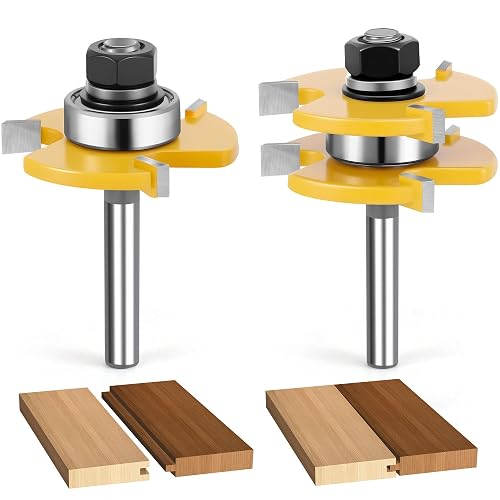 Best for cabinet doorsJunreox 2PCS Tongue and Groove Router Bit Set, 3rd Gen. 1/4 Shank RoutView on Amazon
Our Top Picks
Quick Comparison
| Product | Best for | Key feature |
|---|---|---|
| Precision Wood Joinery Finger Joint & Tongue and Groove Router Bits Set, 1/4 Inch Shank, 3 Pack | General joinery with one set | Reversible profile design |
| Professional Finger Joint Router Bit 1/2″ Shank | Drawers and carcases | Reversible finger joint profile on 1/2″ shank |
| 3pcs 1/2 inch Shank Multi Sided Glue Joint Router Bits | Solid wood, hardwood and chipboard | Multi-sided glue joint geometry |
| 45 Degree Lock Miter Router Bit 3-Piece Set | Mitered box corners | Three cutting heights for 1/2″, 5/8″ and 3/4″ stock |
| Reversible Finger Glue Joint Router Bit 1/2 Inch Shank | Budget-minded finger joints | Bearing-guided reversible design |
| Junreox 2PCS Tongue and Groove Router Bit Set | Shaker cabinet doors and panels | Adjustable 3-tooth profile for 3/4″ stock |
Precision Wood Joinery Finger Joint & Tongue and Groove Router Bits Set, 1/4 Inch Shank, 3 Pack
Precision Wood Joinery; Clean Cutting Performance; Reversible Profile Design; Multi-Material Compatibility Finger Joint & Tongue and Groove Router Bits Set, 1/4 Inch Shank, 3 Pack
Best for: General joinery with one set
This three-piece set covers two of the most common joints in a home shop, finger joints and tongue and groove, so you do not need to buy each profile separately. It suits hobbyists building boxes, shelving and small furniture who want a versatile starting kit.
Key specs
- 1/4 inch shank
- Three-piece set
- Finger joint and tongue and groove profiles
- Reversible profile design
Pros
- Covers two joint types in one purchase
- Reversible design can extend usable life of the profile
- Works with several material types according to the listing
Cons
- 1/4 inch shank limits use in heavier routers
- Smaller shank can be less stable on large-diameter cuts
Bottom line: A strong first purchase for someone who wants versatility across common joints without a large collection of bits.
Professional Finger Joint Router Bit 1/2″ Shank, Reversible Finger Glue Joint Router Bit for Woodworking
Professional Finger Joint Router Bit 1/2" Shank, Reversible Finger Glue Joint Router Bit for Woodworking, Finger Joint Bit, Joinery Router Bit for DIY Door Table Cabinet Shelve Furniture
Best for: Drawers and carcases
Finger joints are among the strongest glued joints for drawer sides and box corners because of the large long-grain glue surface. This 1/2 inch shank bit suits builders making drawers, cabinets and furniture carcases on a router with a 1/2 inch collet.
Key specs
- 1/2 inch shank
- Reversible finger glue joint profile
Pros
- Larger shank improves stability over 1/4 inch options
- Reversible profile suits matching pin and tail cuts
- Well suited to cabinet and drawer projects
Cons
- Setup requires careful alignment of pins and tails
- Single profile, so it does not cover other joint types
Bottom line: The right choice for builders who make a lot of drawers and boxes and want a stable 1/2 inch shank bit.
3pcs 1 2 inch Shank Multi Sided Glue Joint Router Bits, Carbide Woodworking Milling Cutter
3pcs 1 2 inch Shank Multi Sided Glue Joint Router Bits, Carbide Woodworking Milling Cutter for Solid Wood Hardwood Chipboard
Best for: Multi-material work
This three-piece set is described for solid wood, hardwood and chipboard, which makes it useful for shops that switch between materials. It fits builders who want multi-sided glue joint bits for varied panel and frame work.
Key specs
- 1/2 inch shank
- Three-piece set
- Carbide cutting edges
Pros
- Designed for solid wood, hardwood and chipboard
- Three bits give several cutting options in one set
- Carbide construction suits repeated use
Cons
- Brand reputation is less established than major manufacturers
- Chipboard use can dull carbide faster than solid stock
Bottom line: A practical pick for mixed-material shops that need several glue joint profiles on one shank size.
45 Degree Lock Miter Router Bit 3-Piece Set, for 1/2”, 5/8”, 3/4” Cutting Height, 1/4 Inch Shank
45 Degree Lock Miter Router Bit 3-Piece Set, for 1/2”, 5/8”, 3/4” Cutting Height, 1/4 Inch Shank. Easy to Create Lock Miter Joint
Best for: Mitered box corners
Lock miter joints add a mechanical interlock to a standard 45 degree miter, which helps the corner resist separation while the glue cures. This set is aimed at boxes, drawers and cabinet frames made from 1/2, 5/8 and 3/4 inch stock.
Key specs
- 1/4 inch shank
- Three-piece set
- Cutting heights for 1/2″, 5/8″ and 3/4″ stock
- 45 degree profile
Pros
- Covers three common stock thicknesses
- Lock miter joint is stronger than a plain miter
- Good for clean, visible box corners
Cons
- 1/4 inch shank is less stable for large cuts
- Requires matched setup on both mating pieces
Bottom line: Best for woodworkers making boxes and cabinets with visible miter corners who want a set matched to common stock thicknesses.
Reversible Finger Glue Joint Router Bit 1/2 Inch Shank, Newdeli Bearing Finger Joint Router Bits
Reversible Finger Glue Joint Router Bit 1/2 Inch Shank, Newdeli Bearing Finger Joint Router Bits Carbide Joinery Wood Milling Cutter for DIY Door Table Cabinet Shelve Furniture
Best for: Budget-minded finger joints
This reversible finger joint bit uses a bearing-guided design and a 1/2 inch shank, giving beginners a finger joint option without a premium price. It suits hobbyists making their first drawers or small boxes.
Key specs
- 1/2 inch shank
- Reversible finger glue joint profile
- Bearing-guided design
Pros
- Lower-cost entry point for finger joints
- Bearing guide helps with consistent depth control
- Reversible profile for pin and tail matching
Cons
- Brand is less established than premium joinery makers
- Bearing wear can affect cut quality over time
Bottom line: A sensible starting point for beginners who want to learn finger joints and do not yet need a high-end bit.
Junreox 2PCS Tongue and Groove Router Bit Set, 3rd Gen. 1/4 Shank Router Bits for 3/4″ Stock
Junreox 2PCS Tongue and Groove Router Bit Set, 3rd Gen. 1/4 Shank Router Bits for 3/4" Stock, 1/2" Cutting Depth, Adjustable 3 Teeth Shaker Cabinet Door Router Bits for Woodworking, Milling, Cutting
Best for: Shaker cabinet doors and panels
Tongue and groove bits are the standard way to join frame and panel doors and to assemble tongue-and-groove panelling. This two-piece set is listed for 3/4 inch stock and an adjustable three-tooth profile, which suits cabinet door makers.
Key specs
- 1/4 inch shank
- Two-piece set
- Designed for 3/4″ stock
- Adjustable 3-tooth profile
Pros
- Adjustable profile allows fine fitting of tongues
- Matched pair simplifies frame and panel work
- Listed for common 3/4 inch cabinet stock
Cons
- 1/4 inch shank limits use with heavier routers
- Adjustment requires patience to dial in a snug fit
Bottom line: Suited to cabinet door builders who want an adjustable tongue and groove pair for frame and panel work.
Buying Guide
Shank size
Shank diameter (usually 1/4 inch or 1/2 inch) must match your router collet. Larger shanks resist deflection better on wide or deep cuts, while 1/4 inch shanks suit smaller routers and lighter work. Always check the router’s collet specification before buying.
Good picks for this: Professional Finger Joint Router Bit 1/2″ Shank; Reversible Finger Glue Joint Router Bit 1/2 Inch Shank
Joint type
Finger joints, lock miters and tongue and groove joints each suit different builds. Finger joints work well for drawer boxes, lock miters for visible box corners, and tongue and groove for panels and doors. Choose the profile that matches the joint you actually need.
Good picks for this: Precision Wood Joinery Finger Joint and Tongue and Groove Set; 45 Degree Lock Miter Router Bit 3-Piece Set
Stock thickness
Joinery bits are often designed for a specific stock thickness, such as 1/2 inch, 5/8 inch or 3/4 inch. Confirm that your material falls within the bit’s listed cutting range, or you may end up with loose or weak joints.
Good picks for this: 45 Degree Lock Miter Router Bit 3-Piece Set; Junreox 2PCS Tongue and Groove Router Bit Set
Material compatibility
Hardwoods, softwoods, plywood and engineered panels respond differently to cutting. Carbide-tipped bits handle dense hardwood and sheet goods more consistently than high-speed steel. Check the manufacturer’s listed material types before cutting plywood or chipboard.
Good picks for this: 3pcs Multi Sided Glue Joint Router Bits; Precision Wood Joinery Finger Joint and Tongue and Groove Set
Reversibility and profile design
Reversible finger joint bits let you cut matching pins and tails with the same profile by flipping the bit and adjusting height, which reduces the number of bits you need. Reversible designs are efficient, but they still require careful setup to produce a tight fit.
Good picks for this: Reversible Finger Glue Joint Router Bit 1/2 Inch Shank; Professional Finger Joint Router Bit 1/2″ Shank
Bearing guides and setup
Many joinery bits use a bearing to follow a template or edge, which keeps depth and alignment consistent. Check that the bearing spins freely and is seated correctly before each pass. Bearing wear can cause uneven cuts, so inspect it regularly.
Good picks for this: Reversible Finger Glue Joint Router Bit 1/2 Inch Shank; Junreox 2PCS Tongue and Groove Router Bit Set
Care and maintenance
Keep carbide edges clean of pitch and resin with a dedicated cleaner, and store bits in a case to protect the cutting edges. Dull bits cause burning, tear-out and loose joints, so resharpening or replacement should be planned into your workflow.
Good picks for this: 3pcs Multi Sided Glue Joint Router Bits; 45 Degree Lock Miter Router Bit 3-Piece Set
FAQ
What is the best router bit for finger joints?
For most builders, a reversible finger joint bit on a 1/2 inch shank offers good stability and matching pin and tail cuts. The Professional Finger Joint Router Bit 1/2″ Shank is a sound choice for drawers and carcases, while the reversible Newdeli bit is a lower-cost option for beginners.
Do I need a router table to cut joinery bits?
Not always. Many joinery bits can be used handheld with a fence or template, but a router table gives better control for long edges and repeated cuts. Use a table for safer, more consistent results on production work.
What shank size should I choose?
Match the shank to your router’s collet. Choose 1/2 inch shanks when your router supports them, because they resist vibration and deflection better on wide cuts. Choose 1/4 inch shanks only for smaller routers and lighter work.
Can router bits for joining wood cut plywood?
Many joinery bits can cut plywood, but the glue layers and voids can dull carbide quickly. Check the manufacturer’s material list, make shallow passes, and use sharp bits to reduce tear-out and burning.
What is the difference between a lock miter and a regular miter?
A regular miter is a 45 degree cut that relies on glue alone, while a lock miter adds interlocking tongues and grooves that resist separation. Lock miters are stronger for boxes and visible corners, but they require more precise setup.
How do I keep joinery bits from burning or tearing out wood?
Use sharp bits, feed the workpiece at a steady rate, and take shallow passes rather than one deep cut. Cutting with the grain direction in mind and supporting the workpiece also reduces tear-out.
Is a set or a single bit a better buy?
A set is efficient if you plan to make several joint types, because it covers multiple profiles at once. A single bit makes sense if you only need one joint and want to spend more on quality. Consider your current projects before deciding.
Conclusion
The best router bit for joining wood depends on the joint you need, the stock thickness you work with, and the router you own. The Precision Wood Joinery set suits general joinery with one purchase, while the Professional Finger Joint bit is a strong choice for drawers and carcases. The 45 Degree Lock Miter set fits visible box corners, and the Junreox tongue and groove pair suits cabinet doors. Beginners may prefer the lower-cost reversible finger joint bit, while mixed-material shops may find the multi-sided glue joint set most useful. Match the bit to your project, check the shank and cutting range, and test your setup on scrap before cutting finished stock.
Sources
- Workplace safety guidance for operating power tools and routers (osha.gov)
- Consumer safety information on power tool use and guarding (cpsc.gov)
- Forest Products Laboratory research on wood properties and machining behavior (fpl.fs.usda.gov)
Related reading
- Wood Thread Cutting Router Bit: How to Cut Threads in Wood with a Router
- Wood Surfacing Router Bit Review: Is It Worth It? (2026)
- Wood Router Bits Manufacturer: How to Evaluate Quality, Brands and Specs (2026)
- Wood Router Bit for Drill: 3 Best Picks Compared (2026)
- Wood Flattening Router Bit: 5 Best Picks for Slabs and Spoilboards (2026)
- Wood Carving with Router: 5 Best CNC Machines and Bits Compared
About Claire Whitaker
Claire Whitaker is part of our editorial team and reviews and edits our woodworking guides, checking product details against manufacturer specifications and owner feedback.