By Claire Whitaker
Updated November 2026
Looking for cool DIY woodworking projects that you can actually finish? The right project book does most of the planning for you, with cut lists, measured diagrams and build order laid out before you touch a saw. This list covers five books that suit different skill levels, from first-time builders to shop veterans who want more ambitious pieces. Selection criteria: the number and variety of projects, whether plans include cut lists and dimensioned drawings, how clearly joinery and finishing are explained, and the level of experience the book assumes. We did not build the projects ourselves. Rankings reflect specifications and common owner feedback patterns.
Our top picks at a glance
- 1
 TOP CHOICEBest overallThe DIY Woodworking Projects BibleView on Amazon
- 2
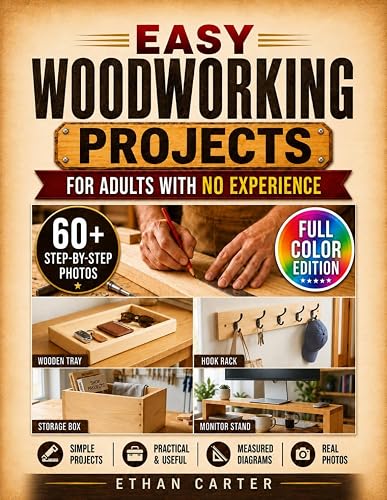 TOP CHOICEBest for complete beginnersEasy Woodworking Projects for Adults with No ExperienceView on Amazon
- 3
 TOP CHOICEBest for learning fundamentalsThe Complete Book of Woodworking (Landauer)View on Amazon
- 4
 Best for home and outdoor buildsGreat Book of Woodworking Projects (Fox Chapel)View on Amazon
- 5
 Best for useful household piecesThe Complete Woodworking Projects for BeginnersView on Amazon
Our Top Picks
| Product | Best for | Key feature |
|---|---|---|
| The DIY Woodworking Projects Bible | Builders wanting broad coverage | 40+ projects plus tools, wood and finishing guidance |
| Easy Woodworking Projects for Adults with No Experience | Absolute beginners | Step-by-step plans with real photos and measured diagrams |
| The Complete Book of Woodworking | Learning core skills | 40+ projects alongside 1,200+ photos and carpentry basics |
| Great Book of Woodworking Projects | Home and outdoor improvements | 50 projects from the American Woodworker editors |
| The Complete Woodworking Projects for Beginners | Practical household pieces | Clear cut lists and illustrated step-by-step plans |
The DIY Woodworking Projects Bible
The DIY Woodworking Projects Bible: [5 in 1] Learn to Build 40+ Projects You'll Be Proud Of | Everything From Choosing Tools and Wood to Cutting Joints and Applying Finishes, No Experience Needed
Best for: Builders who want a wide range of projects and foundational guidance in one volume.
This book suits someone who is curious about woodworking in general and wants to explore many project types before specializing. It covers choosing tools and wood, cutting joints and applying finishes, so it doubles as a reference you will return to after your first builds.
Key specs:
- Listed as covering more than 40 projects
- Scope includes tool selection, wood selection, joinery and finishing
- Marketed as requiring no prior experience
Pros:
- Broad coverage of project types in one book
- Foundational chapters on tools, wood and joinery
- Useful as an ongoing reference
Cons:
- Breadth means individual projects get less depth than a single-focus book
- Beginners may need to supplement with a separate tools guide
Bottom line: A strong first purchase for someone who wants variety and a reference shelf book in one place.
Easy Woodworking Projects for Adults with No Experience
Easy Woodworking Projects for Adults with No Experience: From First Cut to Projects You'll Be Proud to Share | Step-by-Step Plans with Real Photos and Measured Diagrams for Every Build
Best for: Absolute beginners who want guided, photo-supported builds from the first cut.
If you have never run a table saw or read a dimensioned drawing, this title is built around that starting point. Plans are presented with real photos and measured diagrams, which helps you check your progress at each step.
Key specs:
- Step-by-step plans for each build
- Real photos paired with measured diagrams
- Aimed at adult readers with no prior experience
Pros:
- Visual support makes each step easier to verify
- Project scope suits adults building their first furniture pieces
- Measured diagrams reduce guesswork on dimensions
Cons:
- Less depth on advanced joinery than a fundamentals text
- Beginners still need access to basic hand and power tools
Bottom line: The most approachable pick here for a first build, especially if photos help you learn.
The Complete Book of Woodworking (Landauer)
The Complete Book of Woodworking: Step-by-Step Guide to Essential Woodworking Skills, Techniques, Tools and Tips (Landauer) 40+ Easy-to-Follow Projects and Plans, 1,200+ Photos, and Carpentry Basics
Best for: Learning core skills and techniques that apply across many projects.
This is the choice for someone who wants to understand how woodworking works rather than just follow a single plan. The emphasis on techniques and carpentry basics makes it useful alongside any project book you buy later.
Key specs:
- More than 40 easy-to-follow projects and plans
- More than 1,200 photos
- Covers essential skills, techniques, tools and carpentry basics
Pros:
- High photo count supports visual learners
- Skills-first structure transfers to other projects
- Good balance of projects and technique instruction
Cons:
- Large format means it can feel dense for casual readers
- Some project designs may feel dated to modern tastes
Bottom line: Best for builders who want a technique reference that doubles as a project collection.
Great Book of Woodworking Projects (Fox Chapel)
Great Book of Woodworking Projects: 50 Projects for Indoor Improvements and Outdoor Living from the Experts at American Woodworker (Fox Chapel Publishing) Plans & Instructions to Improve Every Room
Best for: Home improvement and outdoor living builds.
Readers focused on improving their house or yard will find this title most useful. The projects are drawn from American Woodworker editors and target both indoor improvements and outdoor structures.
Key specs:
- 50 projects covering indoor and outdoor uses
- Plans and instructions for improving every room
- Content sourced from American Woodworker editors
Pros:
- Strong range of practical home and outdoor projects
- Editorial origin from a well-known woodworking magazine
- Good variety in scale, from small items to larger builds
Cons:
- Outdoor projects require weather-resistant materials and finishes you must source yourself
- Assumes some comfort with basic tools
Bottom line: Ideal if your goal is useful projects around the house and yard.
The Complete Woodworking Projects for Beginners
The Complete Woodworking Projects for Beginners: Build Useful Pieces for Your Home with Basic Tools, Clear Cut Lists, and Illustrated Step-by-Step Plans to Put Your Skills to Work
Best for: Practical household pieces built with basic tools.
This book targets people who want to build useful items for everyday life with a modest tool kit. The clear cut lists and illustrated steps make it straightforward to organize materials before you start.
Key specs:
- Designed around basic tools
- Clear cut lists for each project
- Illustrated step-by-step plans
Pros:
- Cut lists simplify material purchasing
- Projects target everyday household use
- Basic-tool focus keeps entry barriers low
Cons:
- Fewer advanced techniques for experienced builders
- Illustrations may be less detailed than photo-based guides
Bottom line: A practical choice for beginners who want functional pieces with minimal tooling.
Buying Guide
Skill level and instruction style
Match the book to where you are now. Look for whether plans assume prior experience, and whether steps are explained in full or summarized. Photo-heavy books suit visual learners, while diagram-based books suit builders who already read drawings comfortably.
Good picks for this: Easy Woodworking Projects for Adults with No Experience, The Complete Book of Woodworking
Quality of cut lists and dimensioned drawings
A usable plan gives overall dimensions, part counts and cut sizes. Check that cut lists include thickness, width and length for every part, and that drawings show joinery locations. Vague plans cost time and wood.
Good picks for this: The Complete Woodworking Projects for Beginners, Easy Woodworking Projects for Adults with No Experience
Project variety and scope
Decide whether you want breadth or depth. A wide book gives you options across furniture, storage and garden pieces. A narrower book goes deeper into fewer types of builds.
Good picks for this: The DIY Woodworking Projects Bible, Great Book of Woodworking Projects
Joinery and technique coverage
Joinery such as dado, rabbet, mortise and tenon, and pocket screw connections determines how sturdy your builds will be. Look for chapters that explain how to cut each joint, not just where it appears in a drawing.
Good picks for this: The Complete Book of Woodworking, The DIY Woodworking Projects Bible
Use case and project location
Indoor furniture and outdoor structures have different demands. Outdoor builds need weather-resistant species or treated lumber and suitable finishes. Check that the book addresses the environment you plan to build for.
Good picks for this: Great Book of Woodworking Projects, The Complete Woodworking Projects for Beginners
Finishing and durability guidance
A good book explains sanding progression, stain and topcoat choices, and how finish affects longevity. Finishing is where many first projects fail, so this section matters as much as joinery.
Good picks for this: The DIY Woodworking Projects Bible, The Complete Book of Woodworking
Shop tool requirements
Before buying, list the tools you own. Some projects assume a table saw, router or drill press. Books that stress basic tools widen what you can build with a limited shop.
Good picks for this: The Complete Woodworking Projects for Beginners, Easy Woodworking Projects for Adults with No Experience
FAQ
What are the best cool DIY woodworking projects for beginners?
Good first builds are usually small, use few parts and rely on simple joinery. Shelves, step stools, planter boxes and simple benches are common starting points. Choose a book whose beginner projects match the tools you already have.
Do I need a table saw to build these projects?
Not always. Many beginner plans can be executed with a circular saw, a miter saw and clamps, though a table saw makes ripping stock more accurate. Check each book’s tool list before buying.
How do I read a woodworking plan and cut list?
Start with the overall dimensions and parts list. Each part is usually labeled with its quantity, thickness, width and length. Confirm the cut list against the drawing before buying lumber, and allow extra stock for mistakes.
What wood should I use for outdoor DIY projects?
Outdoor pieces need rot-resistant species such as cedar or redwood, or pressure-treated lumber rated for ground contact where appropriate. Use exterior-rated fasteners and finishes. Verify lumber ratings with your supplier.
Are woodworking projects safe for beginners?
Woodworking carries real risks from saws, routers and flying debris. Wear eye and hearing protection, use push sticks, and follow tool manufacturer instructions. For guidance on shop safety, consult a qualified instructor or a professional safety resource.
How long does a typical beginner project take?
Small projects such as a shelf or planter box often take a weekend, depending on finishing time. Larger furniture can take several weeks. Plan extra time for glue drying and finish curing.
Conclusion
For most readers, the best starting point is a book that matches current skill and shop setup. The DIY Woodworking Projects Bible offers the widest scope. Easy Woodworking Projects for Adults with No Experience is the most approachable for first-time builders. The Complete Book of Woodworking suits those who want to learn techniques deeply, while Great Book of Woodworking Projects targets home and outdoor improvement. The Complete Woodworking Projects for Beginners works well for practical household pieces built with basic tools. Pick the one whose projects you would actually want to build.
For more ideas, see DIY Woodworking Projects That Sell: 7 Builds With Plans and Cut Lists, Good First Woodworking Projects: 5 Easy Builds for Beginners, and Wood for Woodworking Projects: A Step-by-Step Guide to Choosing the Right Stock. If you are weighing shop equipment, 6 Best Cool Tools for Woodworking Shops and Projects (2026) covers useful additions.
Sources
- Workplace safety guidance for woodworking machinery and power tools (osha.gov)
- Consumer safety information on power tools and shop hazards (cpsc.gov)
- Wood properties and species information from the USDA Forest Products Laboratory (fpl.fs.usda.gov)
Related reading
- 7 Best DIY Beginner Woodworking Projects Books for First-Time Builders (2026)
- Woodworking Projects with 2x4s: 7 Best Books for Builders of Every Level
About Claire Whitaker
Claire Whitaker is part of our editorial team and reviews and edits our woodworking guides, checking product details against manufacturer specifications and owner feedback.