As an Amazon Associate I earn from qualifying purchases. This page may contain affiliate links.
Choosing a table saw and stand is one of the more practical decisions a woodworker makes, because the saw and its support work as a single system. A saw that wobbles on a flimsy base, sits too low for comfortable feeding, or cannot be moved from the garage to the driveway will slow every project down. Readers searching for a table saw and stand usually want to know which combinations are sturdy enough for accurate rip cuts, portable enough for jobsite work, and well enough made that the included stand will not need replacing after a season. This guide ranks seven options by how well they fit those needs. The selection method is research-based: we reviewed manufacturer specifications, brand reputation for stand stability and fence accuracy, and patterns in owner feedback about setup, transport and dust collection. Nothing here comes from personal testing, so check the current listing before you buy.
Our Top Picks
The table below gives a quick overview. The picks are ordered roughly by how closely they match the most common buying criteria, with portable jobsite combinations first and the stand-only options at the end.
Quick Comparison
| Product | Best for | Key feature |
|---|---|---|
| SKIL 15 Amp 10-Inch Jobsite Table Saw with Folding Stand (TS6307-00) | Budget-minded jobsite and DIY use | Folding stand for compact storage |
| DEWALT 10-Inch Table Saw with Foldable Rolling Table Saw Stand (DWE7491RS) | Frequent site moves with larger stock | Wide 32-1/2-inch rip capacity |
| Evolution R10TBLX 10-Inch Jobsite Table Saw with Wheeled Stand | Users who want a feature-rich wheeled setup | 26-inch rip capacity and dado plate included |
| 10-Inch 15A Portable Jobsite Table Saw with Stand (B0H4CWSRLS) | Hobbyists wanting bevel and angle accessories | Angle stop and push stick included |
| DEWALT Portable Table Saw with Stand, 8-1/4 inch (DWE7485WS) | Compact cuts and trim work | Up to 48-degree angle cuts |
| DEWALT Table Saw Stand, Rolling Stand (DW7440RS) | Owners who already have a compatible saw | Collapsible, lightweight stand |
| DEWALT Table Saw for Jobsite with Table Saw Stand (DWE7485 and DW7440RS) | Mobile shops that want a matched saw-and-stand kit | Compact saw paired with rolling stand |
SKIL 15 Amp 10-Inch Jobsite Table Saw with Folding Stand (TS6307-00)

Folding stand SKIL 15 Amp 10-Inch Jobsite Table Saw with Folding Stand-TS6307-00
This is a practical choice for homeowners and occasional builders who need a saw that folds up and moves between job sites. It suits people who prioritize a compact footprint over maximum capacity.
Key specs
- 10-inch blade size
- 15 amp motor
- Folding stand included
Pros
- The folding stand makes storage in a vehicle or small garage straightforward.
- A 15 amp motor covers common dimensional lumber and sheet goods.
- Its jobsite format is familiar to many builders, which keeps accessory choices broad.
Cons
- Owners often report that the fence and stand can feel less rigid than full-size cabinet saws.
- Rip capacity is more limited than larger jobsite models.
DEWALT 10-Inch Table Saw with Foldable Rolling Table Saw Stand (DWE7491RS)

DEWALT Table Saw 10 Inch with Foldable Rolling Table Saw Stand, 15 Amp, 4800 RPM, 32-1/2-Inch Rip Capacity (DWE7491RS)
This combination suits woodworkers who regularly rip wide boards and need a stand that can be wheeled out of the way between sessions. It is a sensible option for anyone who has outgrown a small saw but does not want a stationary cabinet.
Key specs
- 10-inch blade
- 15 amp motor
- 4800 RPM
- 32-1/2-inch rip capacity
- Foldable rolling stand
Pros
- The 32-1/2-inch rip capacity is substantially wider than most jobsite saws.
- The rolling stand reduces the effort of moving the saw between work areas.
- The stand folds for storage when the saw is not in use.
Cons
- The overall footprint is larger than compact portable saws, which matters in tight spaces.
- Owners sometimes mention that the wheels need occasional adjustment on uneven floors.
Evolution R10TBLX 10″ Jobsite Table Saw with Wheeled Stand

Evolution R10TBLX 10" Jobsite Table Saw with Wheeled Stand | Zero-Clearance Throat Plate | Dado Plate Included | 15A Motor | 26” Rip | 3-3/8” Cut | 0-45° Bevel | Precision Fence | Heavy Duty Portable
This option appeals to users who want a long list of built-in features in one package. It is well suited to general contractors and serious hobbyists who cut varied materials and value accessories included in the box.
Key specs
- 10-inch blade
- 15A motor
- 26-inch rip capacity
- 3-3/8-inch depth of cut
- 0 to 45 degree bevel
- Dado plate and zero-clearance throat plate included
- Wheeled stand
Pros
- The dado plate and zero-clearance throat plate are included, which many buyers would otherwise purchase separately.
- The 26-inch rip capacity handles most sheet goods and wide boards.
- The 0 to 45 degree bevel range covers common angled cuts.
Cons
- Owners often mention that the stand is heavier to position than folding alternatives.
- The feature list means more setup time before the first cut.
10-Inch 15A 5000 RPM Portable Jobsite Table Saw with Stand (B0H4CWSRLS)

0-45° Bevel & 90° Crosscut For 2-9/16" To 3-11/32" Max Cutting Depth, Angle Stop & Push Stick for Woodworking & DIY Table Saw with Stand 10-Inch,15A 5000 RPM Portable Jobsite Table Saw
This is a budget-friendly portable setup for hobbyists building furniture, birdhouses and small shop projects. It fits users who want bevel and crosscut capability with a stand they can move without help.
Key specs
- 10-inch blade
- 15A motor
- 5000 RPM
- 0 to 45 degree bevel
- 90 degree crosscut
- Angle stop and push stick included
Pros
- The included angle stop and push stick support safer, more repeatable cuts.
- The 5000 RPM listing suits clean cuts in hardwoods and softwoods.
- It is a practical entry point for woodworkers new to stationary-style saws.
Cons
- Owners sometimes report that accessory quality varies compared with name-brand saws.
- Brand support and parts availability may be less extensive than major manufacturers.
DEWALT Portable Table Saw with Stand, 8-1/4 inch (DWE7485WS)

DEWALT Portable Table Saw with Stand, 8-1/4 inch, up to 48-Degree Angle Cuts (DWE7485WS)
This is the right pick for users who mostly make smaller or trim-scale cuts and want a lightweight saw with a matching stand. It works well for cabinetry details, craft projects and light remodeling.
Key specs
- 8-1/4-inch blade
- Up to 48 degree angle cuts
- Portable stand included
Pros
- The smaller blade and compact body are easier to carry than 10-inch jobsite saws.
- Up to 48 degree angle cuts expand the range of trim and miter work.
- The DEWALT name carries wide parts and service availability.
Cons
- The 8-1/4-inch blade limits depth of cut compared with 10-inch models.
- Wide sheet goods and thick stock are harder to handle on a smaller table.
DEWALT Table Saw Stand, Rolling Stand (DW7440RS)
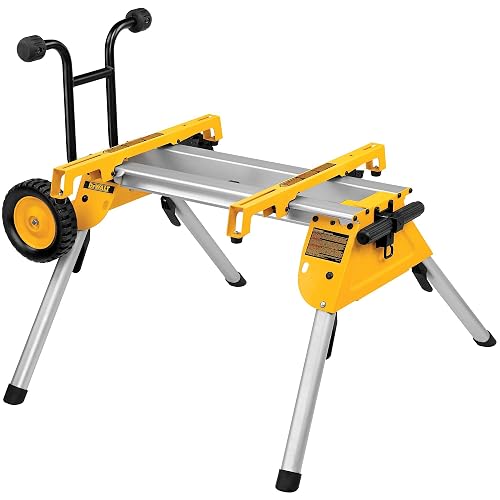
DEWALT Table Saw Stand, Rolling Stand, Collapsible and Portable, Lightweight and Compact (DW7440RS)
This is a stand-only option for owners who already have a compatible DEWALT saw and want a collapsible, rolling base. It is not a complete saw and should be matched to your saw model before purchase.
Key specs
- Collapsible design
- Rolling base
- Lightweight construction
Pros
- Collapsing for storage is practical for garages and small apartments.
- Rolling support reduces lifting when relocating the saw.
- It is a useful upgrade for an existing saw that lacks a proper stand.
Cons
- It must be confirmed as compatible with your saw before buying.
- Owners sometimes mention that lighter stands feel less stable under heavy feed pressure.
DEWALT Table Saw for Jobsite, Compact, 8-1/4-Inch with Table Saw Stand, Mobile/Rolling (DWE7485 and DW7440RS)

DEWALT Table Saw for Jobsite, Compact, 8-1/4-Inch with Table Saw Stand, Mobile/Rolling (DWE7485 & DW7440RS)
This matched kit suits mobile tradespeople and hobbyists who want a saw and rolling stand designed to work together. It is a good fit for anyone who wants to avoid the guesswork of pairing components.
Key specs
- 8-1/4-inch compact saw
- Mobile rolling stand
- Saw and stand sold as a matched combination
Pros
- The saw and stand are designed as a pair, reducing fit concerns.
- The rolling base simplifies moving the setup around a shop or job site.
- Compact dimensions suit smaller workspaces.
Cons
- The smaller blade limits maximum depth of cut.
- Larger sheet goods may require outfeed support not included in the kit.
Buying Guide
Choosing a table saw and stand is easier when you know which factors actually affect your cuts. The saw motor, blade size, fence, and stand all interact, so it helps to look at them as one system rather than separate purchases.
Selection Criteria
Start with the work you do most. Ripping plywood, resawing hardwood, and making small trim pieces each place different demands on a saw. A saw that excels at one may be awkward at another. Consider how often you will move the setup, how much floor space you have, and whether you need a stand that folds, rolls, or stays fixed.
Important Features
- Rip capacity: The distance from the blade to the fence determines how wide a board you can rip. Measure your typical stock before choosing.
- Fence system: A fence that locks square and stays parallel to the blade is essential for accurate cuts.
- Stand stability: A stand should hold the saw level and resist racking when you push stock through the blade.
- Dust port: A good dust port connects to a shop vacuum and reduces cleanup.
- Blade guard and riving knife: These are central to safe operation and should be in good condition on any saw you buy. For more on kickback and guards, see Cutting Wood Safely: Saws, Kickback and Guards.
Specs to Check
- Blade diameter (8-1/4 inch vs. 10 inch) and maximum depth of cut at 90 degrees and at 45 degrees
- Motor amperage and RPM
- Rip capacity to the right of the blade
- Bevel range and whether the bevel stop is positive
- Stand weight, footprint, and whether it locks in the open position
- Included accessories such as dado plates, zero-clearance inserts, and push sticks
Choosing by Need
If you move the saw often, prioritize folding or rolling stands and a lighter saw body. If you cut wide panels, favor a larger rip capacity and a stable stand with solid feet. If you mostly make small, precise parts, an 8-1/4-inch saw with good angle capability may serve you better than a larger blade. Users who already own a saw and need a replacement stand should confirm compatibility before ordering.
Things to Watch Out For
- Wheeled stands can shift on uneven concrete. Check whether the wheels lock.
- Smaller blades cannot cut as deep, which affects thick hardwood.
- Included accessories vary by listing, so confirm what comes in the box.
- Always follow the manufacturer’s manual for setup, blade guard use, and any electrical requirements. If you are unsure about wiring or safe operation, consult a qualified electrician or experienced woodworker.
FAQ
What is the difference between a table saw and stand and a standalone table saw?
A table saw and stand is a saw sold with a support base designed to hold it at working height. A standalone table saw may be a benchtop unit that sits on your own surface, or a cabinet saw that is heavy and built with its own base. Combination kits are often easier for portable use.
Do I need a rolling stand for a table saw?
Not always. A rolling stand is helpful if you move the saw between rooms or job sites. If the saw stays in one shop, a fixed stand with solid feet may offer better stability.
Is an 8-1/4-inch or 10-inch blade better?
A 10-inch blade generally cuts deeper and handles thicker stock more easily. An 8-1/4-inch blade is lighter and suits trim work and smaller projects. The right choice depends on the thickness of material you cut most often.
Can I use a table saw stand with a different saw?
Sometimes, but compatibility depends on mounting pattern, weight rating, and footprint. Check the manufacturer’s specifications for the stand before pairing it with another saw.
How important is rip capacity?
Rip capacity matters if you regularly cut wide boards or plywood sheets. If your projects use narrower stock, a smaller rip capacity may be sufficient and can keep the saw more compact.
What safety features should I look for?
Look for a blade guard, a riving knife or splitter, and a reliable fence. Also learn how to use push sticks and avoid standing directly behind the blade path. Safety practices reduce the risk of kickback, which is covered in more detail in Cutting Wood Safely: Saws, Kickback and Guards.
Should a beginner buy a table saw and stand kit?
A kit can simplify the decision because the saw and stand are matched. Beginners should still review the owner’s manual, learn proper setup, and consider taking a safety course or working with an experienced woodworker before tackling complex cuts.
Conclusion
For homeowners and occasional builders who need portability, the SKIL folding stand model and the DEWALT matched kits are logical starting points. For frequent site moves with wider stock, the DEWALT 10-inch saw with foldable rolling stand offers the most rip capacity among these picks. Users who want a long feature list and a dado plate included should look at the Evolution wheeled setup, while hobbyists who value angle accessories may prefer the 15A portable saw with stand. The DEWALT 8-1/4-inch options suit trim work and compact spaces, and the stand-only DEWALT rolling base is best for owners who already have a compatible saw. Confirm specifications, compatibility, and included accessories before buying, and follow the manufacturer’s safety instructions every time you turn the saw on.