 By Claire Whitaker
Updated November 2026
Easy to make woodworking projects are the best place to start if you have basic tools, limited experience and a shop that might be a corner of the garage. The right guide turns that corner into a working space by giving you clear plans, accurate cut lists and steps you can follow without guessing. The seven picks below were chosen on specification detail (number of projects, quality of diagrams, cut lists and required tools), the reputation of the authors and publishers, and patterns that owners frequently mention in their feedback, such as clarity for first-timers and projects that finish in a weekend.
Our top picks at a glance
- 1
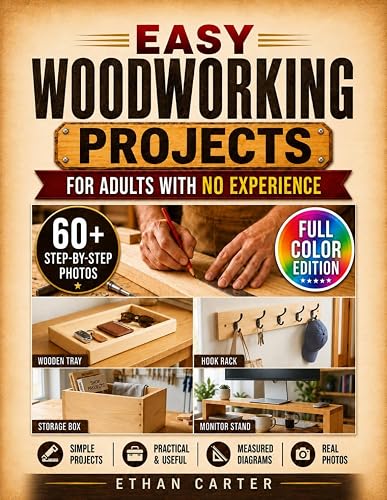 TOP CHOICEBest overallEasy Woodworking Projects for Adults with No ExperienceView on Amazon
- 2
 TOP CHOICEBest for small spacesNo Table Saw Woodworking Projects for BeginnersView on Amazon
- 3
 TOP CHOICEBest for building fundamentalsThe Complete Book of WoodworkingView on Amazon
- 4
 Best for carving beginnersComplete Starter Guide to WhittlingView on Amazon
- 5
 Best for first-time buildersWoodworking Projects for BeginnersView on Amazon
- 6
 Best for using leftover lumberScrap Wood ProjectsView on Amazon
- 7
 Best budget pick for variety100 Weekend Projects Anyone Can DoView on Amazon
Our Top Picks
Quick Comparison
| Product | Best for | Key feature |
|---|---|---|
| Easy Woodworking Projects for Adults with No Experience | Complete beginners | Step-by-step plans with real photos and measured diagrams |
| No Table Saw Woodworking Projects for Beginners | Small spaces and hand-tool or basic-tool shops | Builds that avoid a table saw, with shopping and cut lists |
| The Complete Book of Woodworking | Learning core skills and techniques | 40+ projects alongside carpentry basics and over 1,200 photos |
| Complete Starter Guide to Whittling | Carving on a small scale | 24 projects that can be finished in a weekend |
| Woodworking Projects for Beginners | First-time builders with limited tools | Step-by-step creations needing only basic tools and modest space |
| Scrap Wood Projects | Using offcuts and leftover boards | 22 builds designed around leftover lumber |
| 100 Weekend Projects Anyone Can Do | Trying many project types | 100 DIY projects covering furniture, storage and outdoor spaces |
Easy Woodworking Projects for Adults with No Experience
Easy Woodworking Projects for Adults with No Experience: From First Cut to Projects You'll Be Proud to Share | Step-by-Step Plans with Real Photos and Measured Diagrams for Every Build
Best for: Complete beginners who want a clear path from first cut to a finished piece
This book suits adults who have never built anything beyond a shelf and want a sequence that explains each step before asking for the next one. The emphasis on measured diagrams makes it easier to check your work as you go.
Key specs
- Step-by-step plans for each build
- Real photos and measured diagrams for every project
- Written for readers with no prior experience
Pros
- Projects are sequenced from simple to more involved
- Diagrams show measurements clearly for first-timers
- Builds are practical and suited to giving as gifts
Cons
- Beginners may outgrow the simpler builds quickly
- Some projects still assume a reasonable set of hand and power tools
Bottom line: The strongest choice if you are starting from zero and want guided, photo-supported steps.
No Table Saw Woodworking Projects for Beginners
No Table Saw Woodworking Projects for Beginners: The Easy, Stress-Free Way to Build Useful Things Even in Small Spaces – Exact Shopping & Cut Lists, No Wasted Wood, and the Pride of "I Built That"
Best for: Small spaces and shops without a table saw
If your workspace is limited or you do not own a table saw, this guide shows how to build useful pieces using saws and techniques that fit a modest setup. Shopping lists and cut lists reduce wasted stock, which matters when every board costs you space and money.
Key specs
- Projects designed to avoid a table saw
- Includes shopping and cut lists
- Focus on minimizing wasted wood
Pros
- Works well for apartment or small garage shops
- Cut lists help you buy the right amount of lumber
- Encourages confidence with hand and portable tools
Cons
- Some joinery is slower without a table saw for ripping
- Less coverage of machine setup and safety for larger tools
Bottom line: Ideal for readers who want to build without investing in a table saw first.
The Complete Book of Woodworking
The Complete Book of Woodworking: Step-by-Step Guide to Essential Woodworking Skills, Techniques, Tools and Tips (Landauer) 40+ Easy-to-Follow Projects and Plans, 1,200+ Photos, and Carpentry Basics
Best for: Learning core skills and techniques alongside projects
This reference-style volume pairs more than 40 projects with fundamentals in carpentry and tool use. It works as a shelf reference you return to when you need to learn a joint or check a technique.
Key specs
- 40+ easy-to-follow projects and plans
- Over 1,200 photos
- Covers essential skills, techniques, tools and tips
Pros
- Strong skill-building content alongside projects
- Photo-heavy layout helps visual learners
- Useful as a long-term reference
Cons
- Large format can be less convenient in a small shop
- Some readers may want more detailed cut lists per project
Bottom line: A good pick for readers who want technique and projects in one book.
Complete Starter Guide to Whittling
Complete Starter Guide to Whittling: 24 Easy Projects You Can Make in a Weekend (Fox Chapel Publishing) Whittling for Beginners with Woodcarving Patterns, Step-by-Step Projects, and Easy Carving Tips
Best for: Carving beginners who want small, quick projects
Whittling needs far less equipment than furniture building, which makes it a practical way to practice wood handling and knife control. The projects are small enough to finish in an afternoon or weekend.
Key specs
- 24 projects designed for a weekend
- Woodcarving patterns included
- Step-by-step instruction for beginners
Pros
- Very low tool requirements
- Quick wins that build confidence
- Patterns make it easy to start
Cons
- Not a guide to furniture or case building
- Requires sharp carving knives and careful technique
Bottom line: The right choice if your interest leans toward small carved pieces rather than furniture.
Woodworking Projects for Beginners
Woodworking Projects for Beginners: Lots of Step-by-Step DIY Creations for First-Time Builders. No Experience Needed, Just Basic Tools and a Bit of Space to Make Beautiful, Useful Pieces from Wood
Best for: First-time builders with basic tools and limited space
This title is written for people who have only a few tools and a small area to work in. It emphasizes beautiful, useful pieces that do not require a full shop.
Key specs
- Step-by-step DIY creations
- Designed for basic tools
- Written for readers with no experience
Pros
- Low barrier to entry
- Projects suit modest spaces
- Clear step sequences
Cons
- Less depth on advanced joinery
- Specific project details vary in how much measurement guidance they include
Bottom line: A sensible first book for a beginner with a basic toolkit.
Scrap Wood Projects
Scrap Wood Projects: 22 Easy Woodworking Builds to Turn Leftover Lumber into Useful Things for Your Home
Best for: Using offcuts and leftover boards
Scrap-based projects keep material costs down and reduce waste. This collection is built around the short boards and odd pieces most shops accumulate.
Key specs
- 22 easy woodworking builds
- Designed around leftover lumber
- Focus on home-useful items
Pros
- Practical use for offcuts
- Projects are short and manageable
- Good for practicing joinery on small stock
Cons
- Scrap-only approach limits furniture-scale builds
- Material availability depends on your stash
Bottom line: Best for shops that already have a pile of leftover boards to use.
100 Weekend Projects Anyone Can Do
100 Weekend Projects Anyone Can Do: 100 Easy DIY Projects for Furniture, Storage, Outdoor Spaces, and More (Family Handyman 100)
Best for: Trying many project types before choosing a focus
With a wide range of builds across furniture, storage and outdoor spaces, this title suits readers who want variety. It is useful for finding the kinds of projects you enjoy.
Key specs
- 100 DIY projects
- Covers furniture, storage and outdoor spaces
- Part of the Family Handyman series
Pros
- Large number of options
- Good range of skill levels
- Useful for household projects
Cons
- Not every project is deep enough for skill building
- Because of breadth, each build gets less individual attention
Bottom line: A strong pick for readers who want to sample widely before specializing.
Buying Guide
Skill level and instruction style
Check whether the book explains each step in full or assumes you already know joinery and tool setup. Beginners benefit most from photos, measured diagrams and numbered steps. Readers with some experience may prefer leaner instructions and more project variety.
Good picks for this: Easy Woodworking Projects for Adults with No Experience, Woodworking Projects for Beginners
Tools required
Look at the tool list before buying. A title built around hand tools and a drill suits a small space, while a guide that assumes a table saw, router and jointer needs more equipment. Matching the book to your current tools prevents frustration.
Good picks for this: No Table Saw Woodworking Projects for Beginners, Woodworking Projects for Beginners
Cut lists and material planning
Cut lists with dimensions save time and reduce mistakes at the saw. Shopping lists help you buy the right lumber quantity. Check whether the book includes these, since they make the difference between a smooth build and a trip back to the lumberyard.
Good picks for this: No Table Saw Woodworking Projects for Beginners, Scrap Wood Projects
Project scale and build time
Weekend projects are a good fit for most people, but check the time estimates and the scale of each build. Furniture takes far longer than a shelf or a carved spoon. Choose a book whose projects match the time you have available.
Good picks for this: Complete Starter Guide to Whittling, 100 Weekend Projects Anyone Can Do
Depth of technique coverage
Some books focus on finished projects, while others explain techniques like joinery, sanding and finishing. If you want to grow beyond single builds, prioritize books with a clear section on fundamentals and tool use.
Good picks for this: The Complete Book of Woodworking, Easy Woodworking Projects for Adults with No Experience
Use of reclaimed or leftover material
If you already have offcuts, a scrap-focused book saves money and teaches you to plan around grain and board width. Keep in mind that scrap builds may require more sorting and planing than projects using new stock.
Good picks for this: Scrap Wood Projects, 100 Weekend Projects Anyone Can Do
Durability and finishing guidance
A good project guide explains how to finish pieces for their intended location. Outdoor builds need different sealers and wood choices than indoor furniture. Look for books that mention finishing as part of each plan, not as an afterthought.
Good picks for this: The Complete Book of Woodworking, 100 Weekend Projects Anyone Can Do
FAQ
What are the easiest woodworking projects to start with?
Simple shelves, small boxes, cutting boards and birdhouses are common first builds because they use few joints and a short list of tools. Carving projects are also very accessible if you want to avoid large machines.
Do I need a table saw to build easy projects?
No. Many beginner projects can be built with a hand saw, a drill, a square and a sander. A table saw speeds up ripping long boards, but it is not required for small builds.
How much space do I need for a beginner woodworking shop?
A corner of a garage or a basement area with a sturdy workbench is often enough for hand tools and small portable power tools. Plan for enough room to handle boards safely and to store lumber off the floor.
What wood is best for a first project?
Pine and poplar are common for beginners because they are inexpensive, easy to cut and sand, and widely available. Hardwoods like oak are harder to work but produce durable results once you have more experience.
Are woodworking books better than online plans?
Books offer organized sequences and consistent layouts, which many beginners find easier to follow. Free online plans can be useful too, but quality varies, so check that dimensions and cut lists are complete before you start.
What safety gear should I use when starting out?
Safety glasses and hearing protection are the basics for most tasks. Use a dust mask when sanding and keep your hands clear of blades. Read the manufacturer’s manual for any power tool you use, and consult a professional or local woodworking class if you are unsure about a technique.
Conclusion
For most beginners, Easy Woodworking Projects for Adults with No Experience is the most direct starting point because it explains each step with photos and measured diagrams. If you lack a table saw or have a small space, No Table Saw Woodworking Projects for Beginners fits that situation well. Readers who want to build core skills should consider The Complete Book of Woodworking, while those drawn to small carved pieces will find the Complete Starter Guide to Whittling more useful. Scrap Wood Projects suits shops with leftover stock, and 100 Weekend Projects Anyone Can Do works for readers who want to try many kinds of builds before choosing a direction.
You can also browse our related guides, such as Good First Woodworking Projects: 5 Easy Builds for Beginners for beginner-friendly builds and Choosing a First Woodworking Project: What to Consider to narrow down your first choice.
Sources
- Workplace safety guidance on hand and power tool use, relevant to setting up a safe shop (osha.gov)
- Consumer safety information on power tools and workshop equipment (cpsc.gov)
- Information on wood species, grain and properties from the US Forest Service (fs.usda.gov)
Related reading
- Woodworking Mother's Day Wood Projects: 5 Easy Gifts to Make
- 6 Best Small Woodworking Projects Gifts to Makes in 2026
- Woodworking Projects to Sell on Etsy: 8 Ideas That Move (2026)
About Claire Whitaker
Claire Whitaker is part of our editorial team and reviews and edits our woodworking guides, checking product details against manufacturer specifications and owner feedback.


