 By Claire Whitaker
Updated November 2026
Super easy woodworking projects are the fastest way for a beginner to get comfortable with a saw, a drill and a square without wasting lumber on failed attempts. The right plan book does most of the heavy lifting: it gives you cut lists, measured diagrams and a sequence of steps that matches what a first-timer can realistically do. The five books below were selected by comparing their stated scope, the skill level they target, the types of builds they cover and the patterns owners tend to mention in their feedback. We did not build from these books ourselves, so treat the picks as a research-based shortlist rather than a hands-on verdict.
Our top picks at a glance
- 1
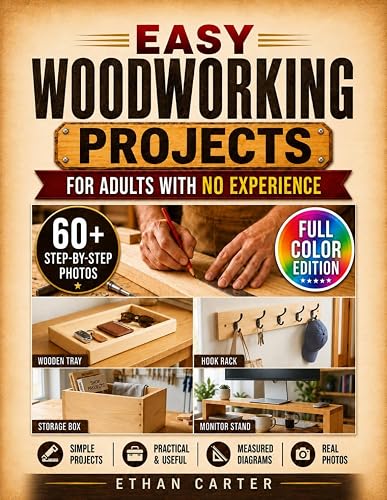 TOP CHOICEBest overallEasy Woodworking Projects for Adults with No ExperienceView on Amazon
- 2
 TOP CHOICEBest for budget-minded beginnersThe Super Easy Woodworking Project for Beginners on a BudgetView on Amazon
- 3
 TOP CHOICEBest for a large variety of builds100 Weekend Projects Anyone Can DoView on Amazon
- 4
 Best for learning fundamentalsSmart Woodworking Projects for BeginnersView on Amazon
- 5
 Best for outdoor projectsSuper Simple Outdoor WoodworkingView on Amazon
Our Top Picks
The table below summarizes the five picks side by side. Each entry lists the main reader it suits and the feature that stands out in the listing.
Quick Comparison
| Product | Best for | Key feature |
|---|---|---|
| Easy Woodworking Projects for Adults with No Experience | Adults starting from zero | Step-by-step plans with real photos and measured diagrams |
| The Super Easy Woodworking Project for Beginners on a Budget | Budget-conscious beginners | Focus on building a basic toolkit and practical home projects |
| 100 Weekend Projects Anyone Can Do | Readers who want variety | 100 projects spanning furniture, storage and outdoor spaces |
| Smart Woodworking Projects for Beginners | Learners who want technique first | Systematic approach to basic tools and avoiding common mistakes |
| Super Simple Outdoor Woodworking | Weekend builders working outside | 15 practical outdoor weekend projects |
Easy Woodworking Projects for Adults with No Experience
Easy Woodworking Projects for Adults with No Experience: From First Cut to Projects You'll Be Proud to Share | Step-by-Step Plans with Real Photos and Measured Diagrams for Every Build
Best for: Adults starting from zero who want a clear path from the first cut to finished pieces.
This book suits someone who has never owned a miter saw and is unsure which tool to reach for first. The layout walks through each build in order, so you are never guessing which board to cut next or how two parts should meet.
Key specs
- Format: step-by-step plans with real photos
- Includes measured diagrams for every build
- Targeted at adult beginners with no prior experience
Pros
- Beginner-friendly sequence from first cut onward
- Photos and diagrams reduce ambiguity in each step
- Projects are scoped to be finished in a reasonable time
Cons
- Less depth on advanced joinery for readers who want to progress quickly
- Projects may feel simple for anyone with prior shop time
Bottom line: The best starting point for an adult who wants guided, photo-supported instructions from the very first project.
The Super Easy Woodworking Project for Beginners on a Budget
The Super Easy Woodworking Project for Beginners on a Budget: Build Your Own Toolkit for Less Than $3 a Day — A Practical Bible for Crafting Beautiful, Useful Home Projects Without Wasting Money
Best for: Budget-conscious beginners who want to build a basic toolkit while making useful home projects.
This title is aimed at readers who want to spend carefully on tools and materials. Its emphasis on a starter toolkit and practical household builds fits someone trying to avoid overbuying equipment before they know what they enjoy.
Key specs
- Focus on building a basic toolkit for beginners
- Covers practical, beautiful, useful home projects
- Written for readers who want to avoid wasted material
Pros
- Clear emphasis on cost-conscious tool and material choices
- Projects target everyday household needs
- Good match for a first-year hobbyist building gradually
Cons
- Less detail on specialized power tools than larger reference books
- Smaller project range compared with multi-hundred-page collections
Bottom line: A sensible choice for a beginner who wants to build skills and a starter kit without overspending on gear.
100 Weekend Projects Anyone Can Do
100 Weekend Projects Anyone Can Do: 100 Easy DIY Projects for Furniture, Storage, Outdoor Spaces, and More (Family Handyman 100)
Best for: Readers who want a wide range of builds to choose from over many weekends.
Part of the Family Handyman series, this collection is organized around practical, achievable projects. It works well as a reference you return to, picking the next build based on the space or gift you need.
Key specs
- 100 projects covering furniture, storage and outdoor spaces
- Published as part of the Family Handyman 100 series
- Aimed at general DIY readers as well as woodworkers
Pros
- Large variety gives plenty of options at every skill level
- Series reputation for practical, home-focused guidance
- Useful as an ongoing reference rather than a single course
Cons
- Not every project is strictly woodworking, so some readers may skip entries
- Individual builds get less depth than a single-project guide
Bottom line: Ideal for someone who wants many easy ideas in one place and expects to pick and choose over time.
Smart Woodworking Projects for Beginners
Smart Woodworking Projects for Beginners: The Complete Step-by-Step System to Build with Basic Tools, Avoid Costly Mistakes, and Create Strong, Professional-Looking Furniture
Best for: Learners who want to understand the technique behind each build, not just follow a sequence.
This book frames its projects around a system: basic tools, common errors and how to produce furniture that looks finished. It suits someone who wants to learn why a joint holds, not only how to assemble it.
Key specs
- Built around a step-by-step learning system
- Covers basic tools and common mistake avoidance
- Focuses on strong, professional-looking furniture
Pros
- Emphasis on technique supports long-term skill growth
- Mistake-avoidance guidance saves time and material
- Furniture-focused projects are useful for home use
Cons
- Projects may require a fuller tool set than the most minimal builds
- Readers wanting quick, simple crafts may find it more involved
Bottom line: A strong pick for a beginner who wants to build real technique alongside each finished piece.
Super Simple Outdoor Woodworking
Super Simple Outdoor Woodworking: 15 Practical Weekend Projects
Best for: Weekend builders who want to work outdoors and make pieces for gardens, patios and yards.
This title focuses on 15 practical outdoor projects. For a beginner, outdoor work has a useful advantage: it needs less precision than fine furniture, and the finished pieces can be built from common dimensional lumber.
Key specs
- 15 practical weekend projects
- Focus on outdoor builds
- Designed for simple, achievable construction
Pros
- Outdoor projects tolerate small imperfections well
- Good scope for a single focused weekend
- Useful for building a garden or patio inventory
Cons
- Narrower focus than general beginner collections
- Outdoor builds need weather-appropriate finishes and fasteners
Bottom line: Best for a beginner whose main interest is outdoor projects and who wants a short, focused set of builds.
Buying Guide
Choosing a plan book is less about page count and more about whether the instructions match your current tools, space and patience. Work through these factors before you buy.
Skill Level Match
Check whether the book assumes you already know how to read a cut list, square a board or cut a rabbet. Books written for adult beginners tend to explain each tool and operation before using it. If you already own a table saw and router, a beginner-only book may feel slow.
Good picks for this: Easy Woodworking Projects for Adults with No Experience, Smart Woodworking Projects for Beginners
Tool Requirements
Scan the project list for the tools each build needs. Many beginner books rely on a drill, a handsaw or a circular saw, plus clamps and a square. Others assume a miter saw or a router. A book that matches the tools you own, or can borrow, will get used far more often.
Good picks for this: The Super Easy Woodworking Project for Beginners on a Budget, Super Simple Outdoor Woodworking
Project Variety
A large collection gives you options, but it can also mean lots of entries you will never build. Look at the mix: are there storage pieces, outdoor builds and small gifts, or is the book narrow? Variety matters more if you plan to keep building for years.
Good picks for this: 100 Weekend Projects Anyone Can Do, Super Simple Outdoor Woodworking
Quality of Diagrams and Cut Lists
Measured diagrams and complete cut lists prevent the most common beginner error: cutting parts to the wrong length. Check whether each project shows dimensions for every part and whether the drawings label joints clearly. Photos of the actual build are a useful bonus.
Good picks for this: Easy Woodworking Projects for Adults with No Experience, Smart Woodworking Projects for Beginners
Intended Use and Setting
Think about where your finished pieces will live. Indoor furniture and storage call for different wood choices, joinery and finishes than outdoor benches or planters. If you plan to build for the yard, a book organized around outdoor work will save time.
Good picks for this: Super Simple Outdoor Woodworking, 100 Weekend Projects Anyone Can Do
Durability of the Finished Build
Beginner projects often fail at the joints or from using the wrong fasteners for the material. Look for a book that explains how to glue, screw and reinforce parts, and that addresses wood movement and outdoor finishes where relevant. Owners often report that books focused on technique hold up better when they try more demanding builds later.
Good picks for this: Smart Woodworking Projects for Beginners, Easy Woodworking Projects for Adults with No Experience
Care, Finishing and Maintenance
Good plan books cover sanding sequence, stain or paint choices and how to protect a piece once built. Finishing is often where beginner projects look unfinished, so a book that gives clear finishing steps is worth more than its page count suggests.
Good picks for this: The Super Easy Woodworking Project for Beginners on a Budget, Super Simple Outdoor Woodworking
FAQ
What are the easiest woodworking projects for a complete beginner?
Simple builds such as small shelves, planter boxes, basic step stools and wall-mounted storage are common starting points. They use straight cuts, basic joints like butt joints with screws or pocket holes, and minimal finishing. Plan books that show cut lists and step-by-step photos make these projects much easier to follow.
Do I need expensive tools to start woodworking?
No. Many beginner projects can be built with a drill, a handsaw or circular saw, a speed square, clamps and sandpaper. More specialized equipment like a table saw or router becomes useful as your projects grow more complex. A good beginner book will list the tools needed for each build.
How long does a beginner woodworking project usually take?
Most simple projects take a single weekend, though finishing, such as stain drying time, can stretch the schedule. Larger furniture pieces may take several weekends. Check the project description in your plan book; well-written books often estimate build time.
What wood should a beginner use for practice builds?
Common softwoods like pine or spruce are inexpensive, easy to cut and forgiving of mistakes. Pine is widely available at home centers and works well for shelves, boxes and outdoor projects when treated or sealed. Hardwoods are harder to work and better saved until you are more comfortable with your tools.
Are plan books better than free online plans?
Plan books tend to offer consistent formatting, tested-looking diagrams and complete cut lists in one place, which many beginners find easier to follow. Free plans can be excellent but vary widely in quality. Owners often report that a single well-organized book is less frustrating than piecing together several free sources.
How do I avoid the most common beginner mistakes?
Measure twice, mark clearly and check that your square is accurate before cutting. Dry-fit assemblies before gluing, and keep track of which face of each board is the show face. Work slowly with power tools, use clamps generously and follow the sequence in your plan instead of improvising.
Conclusion
Among these five books, Easy Woodworking Projects for Adults with No Experience is the most straightforward starting point for adults who want photo-supported steps from the first cut. The Super Easy Woodworking Project for Beginners on a Budget suits readers focused on keeping spending low while building a starter toolkit. 100 Weekend Projects Anyone Can Do works best if you want a large menu of ideas to return to. Smart Woodworking Projects for Beginners fits a learner who wants technique explained alongside each build. Super Simple Outdoor Woodworking is the right choice when your interest is in garden and patio pieces. Match the book to your skill level, your tools and where the finished projects will live, and you will spend more time building and less time guessing.
Sources
- Power tool and workshop safety guidance, including recommendations for eye and hearing protection and safe use of saws (cpsc.gov)
- Workplace and shop safety standards covering hand tools, power tools and guarding (osha.gov)
- Forest Products Laboratory research on wood properties, moisture movement and the behavior of common lumber species (fpl.fs.usda.gov)
Before you buy: helpful guides
Related reading
- Choosing a First Woodworking Project: What to Consider
- YouTube Woodworking Projects That Sell: 7 Builds for Your Channel (2026)
- Woodworking Projects with 2x4s: 7 Best Books for Builders of Every Level
About Claire Whitaker
Claire Whitaker is part of our editorial team and reviews and edits our woodworking guides, checking product details against manufacturer specifications and owner feedback.