 By Colin Foster
Updated November 2026
Anyone who wants a sturdy, tilting surface for sketching, layout or hobby drafting can build one from woodworking plans for a drafting table. The right plan depends on your skill level, the tools you already own and whether you want a full working guide or a broader reference. The picks below were selected by reviewing product listings, publisher reputation and the kinds of feedback owners commonly report, with attention to clarity of cut lists, diagrams and build sequence.
Our top picks at a glance
- 1
 TOP CHOICEBest overallTables: With Plans and Complete Instructions for 10 TablesView on Amazon
- 2
 TOP CHOICEBest for a first workbench-style buildMake Your Own Workbench: Instructions & Plans to Build the Most ImportView on Amazon
- 3
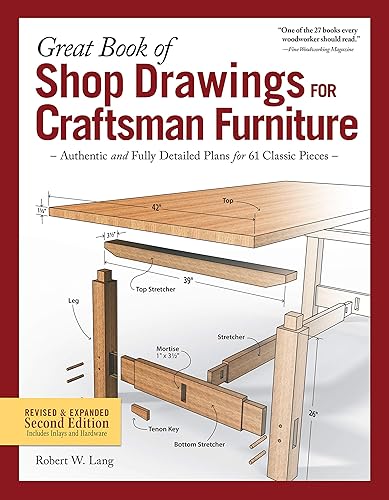 TOP CHOICEBest for classic furniture detailGreat Book of Shop Drawings for Craftsman Furniture, Revised & Expanded Second EditionView on Amazon
- 4
 Best for adjustable-height planningProject Paper Plan To Build Router Table – Material Not IncludedView on Amazon
- 5
 Best for outdoor and garden piecesHow to Make Outdoor & Garden Furniture: Instructions for Tables, ChairView on Amazon
- 6
 Best for multi-project value2-in-1 Woodworking Plans: Cross-Leg End Table & Farmhouse 5-Drawer ChestView on Amazon
Our Top Picks
| Product | Best for | Key feature |
|---|---|---|
| Tables: With Plans and Complete Instructions for 10 Tables | Broad table-building skills | Ten table designs included |
| Make Your Own Workbench | First sturdy shop project | Workbench build instructions |
| Great Book of Shop Drawings for Craftsman Furniture | Detailed reference drawings | Full-perspective views |
| Project Paper Plan To Build Router Table | Shop-tool station planning | Single-project paper plan |
| How to Make Outdoor & Garden Furniture | Outdoor-style builds | 22 step-by-step projects |
| 2-in-1 Woodworking Plans: Cross-Leg End Table & Farmhouse 5-Drawer Chest | Two builds in one package | Cut lists and diagrams |
Tables: With Plans and Complete Instructions for 10 Tables
Tables: With Plans and Complete Instructions for 10 Tables (Taunton Furniture Projects Series)
Best for: Broad table-building skills
This collection suits builders who want several table designs and the joinery to go with them, so a drafting-style top can be adapted from a related plan.
Pros
- Ten table designs in one volume
- Instructions cover joinery and assembly
Cons
- Drafting tilt mechanism is not the main focus
Make Your Own Workbench: Instructions & Plans to Build the Most Important Project in Your Shop
Make Your Own Workbench: Instructions & Plans to Build the Most Important Project in Your Shop
Best for: First sturdy shop project
A good fit for beginners who want to learn heavy, square construction before tackling a hinged drafting surface.
Pros
- Teaches flat, square, stable construction
- Skills carry over to drafting table frames
Cons
- Workbench focus, so the tilt top needs your own design
Great Book of Shop Drawings for Craftsman Furniture, Revised & Expanded Second Edition
Great Book of Shop Drawings for Craftsman Furniture, Revised & Expanded Second Edition: Authentic and Fully Detailed Plans for 61 Classic Pieces (Fox Chapel Publishing) Complete Full-Perspective Views
Best for: Detailed reference drawings
Builders who like to work from full-scale-style drawings and craftsman-era proportions will find this volume useful for scaling a table frame.
Pros
- Full-perspective views aid visualization
- Dozens of furniture pieces in one book
Cons
- Not a dedicated drafting-table guide
Project Paper Plan To Build Router Table – Material Not Included
Project Paper Plan To Build Router Table – Material Not Included
Best for: Shop-tool station planning
This single paper plan is aimed at woodworkers who want a focused, one-project layout they can follow closely and adapt to a drafting surface.
Pros
- Single-project plan keeps focus tight
- Useful for learning a stable base frame
Cons
- Router table, not a drafting table, so adaptation is required
How to Make Outdoor & Garden Furniture: Instructions for Tables, Chairs, Planters, Trellises & More
How to Make Outdoor & Garden Furniture: Instructions for Tables, Chairs, Planters, Trellises & More from the Experts at American Woodworker (Fox Chapel Publishing) 22 Decorative Step-by-Step Projects
Best for: Outdoor-style builds
Suited to builders who want sturdy, weather-minded construction and are comfortable adapting outdoor table designs indoors.
Pros
- 22 step-by-step projects
- Emphasis on durable, practical construction
Cons
- Outdoor focus means indoor drafting features need extra planning
2-in-1 Woodworking Plans: Cross-Leg End Table & Farmhouse 5-Drawer Chest
2-in-1 Woodworking Plans: Cross-Leg End Table & Farmhouse 5-Drawer Chest – Step-by-Step Building Guides, Cut Lists & Diagrams
Best for: Two builds in one package
Good for builders who want cut lists and diagrams for two furniture pieces and plan to apply the same frame logic to a drafting table.
Pros
- Cut lists and diagrams included
- Two projects for the price of one plan set
Cons
- Neither project is a drafting table
Buying Guide
Skill Level and Build Complexity
Start by honestly assessing your experience. Beginners will do better with plans that include detailed cut lists, clear diagrams and step-by-step sequences, while experienced builders may prefer concise plans that leave more design decisions to them.
Check whether a plan is built for a single project or serves as a broader reference across many pieces. A focused guide suits a first drafting table, whereas a multi-project book suits someone planning a whole shop of furniture.
Completeness of Cut Lists and Diagrams
Good woodworking plans list every part with its dimensions, quantity and material. Look for full-size or scaled diagrams that show joinery, angles and hardware placement, since these details prevent costly mistakes at the saw.
Plans that include exploded views or complete perspective drawings make it easier to visualize how the pieces fit together before you commit to cutting stock.
Tools and Shop Setup You Already Have
Review the tools each plan assumes you own. Some drafting table designs rely on a router, a table saw or specialized jigs, while others can be built with basic hand tools and a drill.
Also consider whether the plan includes its own materials list. Some plans are paper or digital guides that leave sourcing entirely to you, so factor in the time and cost of buying lumber and hardware.
Format and Ease of Reference
Decide whether you prefer a printed book you can keep open in the shop or a single printed plan sheet you can pin to the wall. Bound books hold up well to repeated reference, while individual plan sheets are easier to store for one project.
Consider how the instructions are organized. Clear section headings, numbered steps and labeled drawings save time when you are switching back and forth between the plan and your workpiece.
Publisher Reputation and Revision Date
Plans from established woodworking publishers tend to be checked for accuracy and clarity, which matters when a small measurement error can throw off an entire build. Check the edition or revision date so you know the plan reflects current standards and techniques.
FAQ
Do I need advanced skills to build a drafting table from a plan?
Not necessarily. Many drafting table plans are written for intermediate builders, and beginners can succeed with a plan that includes detailed steps and clear diagrams. Choose a project that matches your current comfort level with measuring, cutting and assembly.
What tools are most important for these woodworking plans?
A reliable saw, a drill with bits, a square, clamps and a measuring tape cover most builds. Some plans call for a router or table saw for specific joinery or angled parts, so read the tools section before you buy.
Should I choose a single-project plan or a multi-project book?
A single-project plan is ideal if you want to build one drafting table and nothing else. A multi-project book makes more sense if you plan to build several pieces over time, since you get additional designs and reference material in one purchase.
Are the materials included with these plans?
In most cases, no. Plans typically provide cut lists and material specifications, but you will need to purchase the lumber, hardware and finishing supplies yourself. Always confirm this detail before ordering.
How do I know if a plan is accurate?
Look for plans from reputable publishers, check the revision date and compare the cut list with the diagrams for consistency. Measuring a few key dimensions against the drawings before cutting can help you catch errors early.
Can I modify a plan to fit my workspace or preferences?
Yes, and many builders do. Adjust the overall height, tilt mechanism or storage features as needed, but recalculate the cut list and check that changes do not compromise stability or the work surface angle.
Conclusion
Beginners who want a clear, guided build should prioritize plans with detailed cut lists, diagrams and step-by-step instructions, and the broader multi-project books suit builders who want reference material for future pieces. Those with more experience and specific tools in their shop can choose focused plans that match their equipment and design preferences.
If you plan to build only one drafting table, a dedicated single-project plan is usually the most efficient choice. Anyone building a full shop of furniture will get more value from a comprehensive reference book.
Related reading
- Woodworking Work Table Plans: Build a Sturdy Bench in 6 Steps
- Woodworking Shop Table Plans: 6 Build Steps for a Sturdy Workbench
- Woodworking Plans for Tables: A Step-by-Step Guide to Building Your First One
- Woodworking Plans Side Table: A Step-by-Step Build for Beginners
- Woodworking Plans Coffee Table: 6 Steps to a Sturdy Build
- Woodworking Picnic Table Plans: A Step-by-Step Build for Beginners
About Colin Foster
Colin Foster is part of our editorial team and reviews and edits our woodworking guides, checking product details against manufacturer specifications and owner feedback.