 By Claire Whitaker
Updated November 2026
Finding easy woodworking projects DIY builders can actually finish is harder than it sounds. Many plan books assume a full shop, expensive machines, or years of experience, and that leaves a first-time builder staring at a page of joinery diagrams with no idea where to start. This list focuses on books built around simple builds, clear measurements, and cut lists that make sense with a basic set of hand and power tools. Each pick was judged on how complete its plans are, how much it assumes about your workshop, and how well its projects suit someone building their first pieces.
Our top picks at a glance
- 1
 TOP CHOICEBest overallDIY Woodworking Projects for Beginners: 127 Build-Ready Plans, Exact MView on Amazon
- 2
 Best for weekend builds100 Weekend Projects Anyone Can Do: 100 Easy DIY Projects for FurniturView on Amazon
- 3
 Best budget pick30 DIY Woodworking Projects for Beginners!View on Amazon
- 4
 Best for small workspaces101 Woodworking Projects to Build at Home: Simple DIY Builds for BeginView on Amazon
Our Top Picks
Quick Comparison
| Product | Best for | Key feature |
|---|---|---|
| DIY Woodworking Projects for Beginners: 127 Build-Ready Plans | Builders who want the most plans in one place | Exact measurements and cut lists for each build |
| 100 Weekend Projects Anyone Can Do | Short builds finished in a weekend | Broad mix of furniture, storage, and outdoor projects |
| 30 DIY Woodworking Projects for Beginners! | A focused starter library | Compact set of beginner-level builds |
| 101 Woodworking Projects to Build at Home | Builders with limited space and basic tools | Projects designed around scrap wood and simple setups |
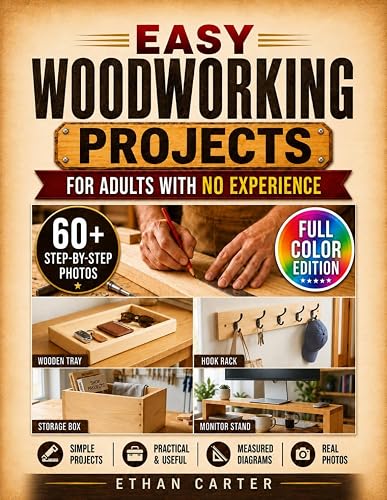
DIY Woodworking Projects for Beginners: 127 Build-Ready Plans, Exact Measurements, Cut Lists & Visual Steps to Turn Raw Boards into Furniture & Decor That Looks Store-Bought | No Big Workshop
DIY Woodworking Projects for Beginners: 127 Build-Ready Plans
Best for: Builders who want the most plans in one place
This book suits someone who wants a large catalog of builds to work through, from shelves and boxes to small furniture pieces. Its focus on exact measurements and visual steps makes it easier to follow than plans that leave dimensions to the reader.
Key specs
- 127 build-ready plans
- Exact measurements and cut lists
- Visual step-by-step instructions
Pros
- Large number of projects to choose from
- Cut lists reduce planning time before cutting
- Visual steps help beginners check their progress
Cons
- Some builds may require more tools than a minimal setup
- Large catalog can feel overwhelming for a first project
Bottom line: The best starting point for a builder who wants many complete plans and clear cut lists in a single book.
100 Weekend Projects Anyone Can Do: 100 Easy DIY Projects for Furniture, Storage, Outdoor Spaces, and More (Family Handyman 100)
100 Weekend Projects Anyone Can Do
Best for: Short builds finished in a weekend
This title is aimed at people who want satisfying results without a long commitment. The projects span furniture, storage, and outdoor spaces, so a reader can pick something that matches a free weekend and their available material.
Key specs
- 100 projects in one volume
- Covers furniture, storage, and outdoor builds
- Part of the Family Handyman 100 series
Pros
- Projects are scoped for short build times
- Good variety across indoor and outdoor work
- Suits builders who like to plan by season
Cons
- Not every project is woodworking-specific, so some builds may use mixed materials
- Plans may be less detailed than dedicated woodworking titles
Bottom line: A good pick for a builder who wants quick wins and a wide range of ideas for around the home and yard.
30 DIY Woodworking Projects for Beginners!
30 DIY Woodworking Projects for Beginners!
Best for: A budget-friendly starter library
This book is a compact option for someone who wants a manageable number of projects rather than a large catalog. It works well for a builder who wants to learn a few core skills before tackling bigger pieces.
Key specs
- 30 beginner-focused projects
- Compact format for a focused learning path
Pros
- Limited set keeps the choice simple
- Good for building a first set of skills in order
- Projects are framed for newcomers
Cons
- Fewer options than larger plan collections
- Detail level may vary between projects
Bottom line: A sensible choice for a first-time builder who wants a short, focused list to start with.
101 Woodworking Projects to Build at Home: Simple DIY Builds for Beginners Using Basic Tools, Scrap Wood, and Limited Workspace
101 Woodworking Projects to Build at Home
Best for: Builders with limited space and basic tools
This book is oriented toward home workshops where space and tool budgets are tight. Its emphasis on scrap wood and simple setups makes it a practical companion for a garage or spare-room bench.
Key specs
- 101 simple builds
- Designed around basic tools and scrap wood
- Suited to limited workspace
Pros
- Projects are planned around small setups
- Scrap-wood focus lowers material planning stress
- Large number of ideas for a first year of builds
Cons
- Scrap-based builds can vary in size and fit
- Some plans may still assume a few specialty tools
Bottom line: The right fit for a home builder working in a small space with a modest tool kit.
Buying Guide
Plan Completeness
Look for books that give exact dimensions, a full cut list, and a material count for each build. Plans that only show a rough sketch often leave you guessing at joint sizes, which is where first projects usually go wrong.
Good picks for this: DIY Woodworking Projects for Beginners: 127 Build-Ready Plans, 101 Woodworking Projects to Build at Home
Tool Requirements
Check which tools each project expects. Easy builds generally rely on a handsaw or circular saw, a drill, clamps, and sandpaper. If a book leans heavily on a table saw or router, expect the early chapters to be harder going without those machines.
Good picks for this: 101 Woodworking Projects to Build at Home, 100 Weekend Projects Anyone Can Do
Project Size and Scale
Smaller projects such as boxes, shelves, and planters are better first builds than tables or cabinets. Scale up only after you can cut square and assemble without racking.
Good picks for this: 30 DIY Woodworking Projects for Beginners!, 100 Weekend Projects Anyone Can Do
Build Time
Consider how long a project takes from raw stock to finish. Glue-up and finish drying can add days, so a project listed as a weekend build may still need extra time for curing.
Good picks for this: 100 Weekend Projects Anyone Can Do, 30 DIY Woodworking Projects for Beginners!
Material Sourcing
Some books specify premium hardwood, while others use dimensional lumber or scrap. If you plan to use construction lumber, make sure the plans account for its actual thickness, which is often less than the nominal size.
Good picks for this: 101 Woodworking Projects to Build at Home, DIY Woodworking Projects for Beginners: 127 Build-Ready Plans
Skill Progression
A good beginner book orders projects from simple to more involved. Look for a clear path so you learn joinery and finishing step by step rather than jumping ahead.
Good picks for this: DIY Woodworking Projects for Beginners: 127 Build-Ready Plans, 30 DIY Woodworking Projects for Beginners!
Safety and Shop Habits
Every build involves saws, clamps, and dust. Plans should mention eye and hearing protection and basic shop safety. Woodworking tools can cause serious injury, so if you are unsure about a machine, consult an experienced woodworker or a qualified instructor before using it.
Good picks for this: 101 Woodworking Projects to Build at Home, 100 Weekend Projects Anyone Can Do
FAQ
What are the easiest woodworking projects for a complete beginner?
Simple boxes, wall shelves, planters, and basic benches are common first builds. They use straight cuts, butt or pocket-screw joints, and minimal finishing, which lets you practice measuring and squaring before attempting more complex joinery.
Do I need a table saw for easy woodworking projects?
Not necessarily. Many beginner builds can be done with a handsaw, circular saw, or a miter saw from a lumber yard cut. A table saw speeds up rip cuts, but it is not required for the first several projects.
What wood should beginners use?
Pine and poplar are widely recommended because they are easy to cut, inexpensive, and forgiving. Construction lumber works for rough builds, but check the actual thickness before following a plan.
How long does a typical beginner woodworking project take?
Small projects often take a single afternoon to a weekend, including cutting and assembly. Finishes need additional drying time, so plan for extra days if you apply stain or multiple coats.
Are cut lists important for first-time builders?
Yes. A cut list tells you exactly how many pieces to cut and their dimensions, which reduces waste and prevents mistakes. Plans with clear cut lists are a good sign of a beginner-friendly book.
What safety gear should I use?
At minimum, wear safety glasses and hearing protection, and use a dust mask when sanding. Keep your hands clear of blades and clamp work securely. For any tool you have not used before, consult an experienced woodworker or a qualified instructor.
Can I build these projects in a small space?
Yes. Many beginner projects are designed for a folding workbench or a corner of a garage. Break larger pieces into sub-assemblies so you can work on them at a small bench.
Conclusion
For most first-time builders, DIY Woodworking Projects for Beginners: 127 Build-Ready Plans offers the most complete set of plans with exact measurements and cut lists. If weekend-sized builds are your goal, 100 Weekend Projects Anyone Can Do covers a wide range of ideas. For a short, focused starter list, 30 DIY Woodworking Projects for Beginners! keeps choices simple. Builders working in a small space with basic tools will find 101 Woodworking Projects to Build at Home most practical. Pick the book that matches your time, space, and tool kit, then start with the simplest build on the list.
For more ideas, see DIY Woodworking Projects That Sell: 7 Builds With Plans and Cut Lists and Good First Woodworking Projects: 5 Easy Builds for Beginners. If you are still choosing your first build, Choosing a First Woodworking Project: What to Consider walks through the main decisions.
Sources
- Workplace tool and machine safety guidance that applies to woodworking shops (osha.gov)
- Consumer product safety information on power tools and workshop equipment (cpsc.gov)
- Guidance on wood species, lumber, and sustainable sourcing practices (nps.gov)
Related reading
About Claire Whitaker
Claire Whitaker is part of our editorial team and reviews and edits our woodworking guides, checking product details against manufacturer specifications and owner feedback.