By Claire Whitaker
Updated November 2026
If you are looking for software to plan woodworking projects, you probably have a shop full of half-finished sketches and a stack of cut lists scribbled on scrap paper. The right program can turn a rough idea into a dimensioned drawing, a materials list and a build sequence you can actually follow. This guide compares five resources that woodworkers commonly use to plan builds. We judged each one on how well it supports planning (dimensioned drawings, cut lists, step-by-step sequences), how clearly it is organized for a beginner or intermediate builder, the range of projects it covers, and the consistency of feedback from owners about accuracy and usefulness. This is a research-based comparison, not a hands-on test.
Our top picks at a glance
- 1
 TOP CHOICEBest overallThe Complete Woodworking Projects for BeginnersView on Amazon
- 2
 TOP CHOICEBest for CNC planningComplete Guide to CNC WoodworkingView on Amazon
- 3
 TOP CHOICEBest for high-volume plan librariesDIY Woodworking Projects for BeginnersView on Amazon
- 4
 Best for furniture-focused buildersThe Weekend Woodworker's Project BibleView on Amazon
- 5
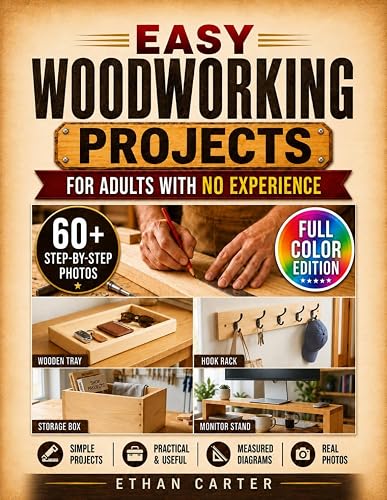 Best for first-timersEasy Woodworking Projects for Adults with No ExperienceView on Amazon
Our Top Picks
Quick Comparison
| Product | Best for | Key feature |
|---|---|---|
| The Complete Woodworking Projects for Beginners | Beginners building useful home pieces | Clear cut lists with illustrated steps |
| Complete Guide to CNC Woodworking | Builders planning CNC-cut work | Step-by-step CNC projects and fixtures |
| DIY Woodworking Projects for Beginners | Builders wanting many plans to choose from | 127 plans with exact measurements |
| The Weekend Woodworker’s Project Bible | Furniture-focused builders on a short schedule | All-in-one collection of easy builds |
| Easy Woodworking Projects for Adults with No Experience | Absolute beginners | Real photos and measured diagrams |
The Complete Woodworking Projects for Beginners
The Complete Woodworking Projects for Beginners: Build Useful Pieces for Your Home with Basic Tools, Clear Cut Lists, and Illustrated Step-by-Step Plans to Put Your Skills to Work
Best for: Beginners who want a practical planning reference for useful home pieces.
This title suits someone who has basic hand and power tools and wants to move from ideas to finished pieces without first learning a drafting program. The listing emphasizes clear cut lists and illustrated step-by-step plans, which are the core planning outputs most builders need.
Key specs:
- Focus: useful pieces for the home
- Includes cut lists and illustrated step-by-step plans
- Designed around basic tools
Pros:
- Cut lists are organized for direct use at the saw
- Illustrations help you check your sequence before cutting
- Good starting point for building planning habits
Cons:
- Printed plans cannot be easily resized to custom dimensions
- Limited for complex joinery planning
Bottom line: A strong pick for beginners who want reliable, ready-to-build plans with cut lists rather than open-ended design software.
Complete Guide to CNC Woodworking
Complete Guide to CNC Woodworking: Everything You Need to Know to Use Any CNC Router (Fox Chapel Publishing) 19 Skill-Building Step-by-Step Projects from Clamps and Fixtures to Box Inlays
Best for: Builders planning projects for a CNC router.
If your planning workflow involves a CNC router, this book covers the setup, fixtures and clamping approaches that determine whether a design can be cut accurately. It is a better fit for someone adding CNC to an existing hand-tool shop than for a first-time builder.
Key specs:
- Covers any CNC router, with step-by-step projects
- Includes 19 skill-building projects
- Projects range from clamps and fixtures to box inlays
Pros:
- Teaches fixture planning, which many CNC users overlook
- Projects build skills progressively
- Useful for planning toolpaths and setup order
Cons:
- Assumes access to a CNC machine
- Not focused on general furniture planning
Bottom line: Choose this if CNC work is part of your planning process; skip it if you only use hand and conventional power tools.
DIY Woodworking Projects for Beginners
DIY Woodworking Projects for Beginners: 127 Build-Ready Plans, Exact Measurements, Cut Lists & Visual Steps to Turn Raw Boards into Furniture & Decor That Looks Store-Bought | No Big Workshop
Best for: Builders who want a large library of plans to pick from.
This title is aimed at people who want to browse many designs and find one that matches their space and skill. The volume of plans makes it useful for generating project ideas, then checking the measurements and cut lists before you commit to a build.
Key specs:
- 127 build-ready plans
- Exact measurements and cut lists
- Visual steps for each build
Pros:
- Large number of options in one place
- Measurements and cut lists are provided for each plan
- Visual steps help with sequencing
Cons:
- With that many plans, depth per project can be limited
- Double-check dimensions against your own lumber stock
Bottom line: A good choice for builders who want variety and ready-made measurements for home decor and small furniture.
The Weekend Woodworker’s Project Bible
The Weekend Woodworker’s Project Bible: The All-in-One Collection of Step-by-Step Plans for Easy Builds, Timeless Furniture & Creative Projects You’ll Be Proud Of | No Experience or Big Budget Needed
Best for: Furniture-focused builders working on short schedules.
The listing positions this collection around easy builds and timeless furniture that can be finished in a weekend. It fits someone who wants planned, achievable projects and does not have a large workshop or a big budget for materials.
Key specs:
- All-in-one collection of step-by-step plans
- Covers easy builds, furniture and creative projects
- Written for builders with no experience or a big budget
Pros:
- Projects are scoped to short build times
- Covers furniture, which many planning guides skip
- Step-by-step format is easy to follow at the bench
Cons:
- Limited detail for advanced joinery
- Plans are fixed; customizing dimensions takes extra work
Bottom line: Pick this if you want furniture plans that fit into a weekend schedule and a modest shop.
Easy Woodworking Projects for Adults with No Experience
Easy Woodworking Projects for Adults with No Experience: From First Cut to Projects You'll Be Proud to Share | Step-by-Step Plans with Real Photos and Measured Diagrams for Every Build
Best for: Absolute beginners who learn best from photos and diagrams.
This book is written for adults starting from the first cut. The real photos and measured diagrams make it easier to understand each stage of a build, which helps when you are still learning how a plan translates into physical steps.
Key specs:
- Step-by-step plans with real photos
- Measured diagrams for every build
- Designed for adults with no prior experience
Pros:
- Photos show what finished steps should look like
- Measured diagrams are clear for beginners
- Good introduction to planning a full build
Cons:
- Beginner-level projects may feel basic for experienced builders
- Less emphasis on advanced planning tools
Bottom line: The most approachable option here for someone just starting out and wanting visual guidance.
Buying Guide
Planning outputs: cut lists, drawings and sequences
Before choosing a resource, decide what you need it to produce. A cut list tells you how many parts to cut and their sizes. A drawing shows how the parts fit together. A build sequence tells you the order of assembly, which matters when glue-ups and finishing must happen in stages. Check whether the resource gives you all three or only one.
Good picks for this: The Complete Woodworking Projects for Beginners, DIY Woodworking Projects for Beginners
Skill level and the learning curve
A planning tool that assumes advanced knowledge will slow you down. Look for clear illustrations, plain-language instructions and a range of difficulty. Beginners benefit most from photos and measured diagrams; more experienced builders can use shorter references.
Good picks for this: Easy Woodworking Projects for Adults with No Experience, The Weekend Woodworker’s Project Bible
Project type and scope
Match the resource to what you build. Furniture, decor, outdoor pieces and CNC-cut work each call for different planning details. A broad library helps you explore; a focused guide gives more depth in one area.
Good picks for this: The Weekend Woodworker’s Project Bible, Complete Guide to CNC Woodworking
Measurement accuracy and adaptability
Printed or fixed plans give you exact dimensions, but they rarely match the lumber you have on hand. Check whether the plan lists dimensions that are easy to adjust. Always verify final sizes against your actual stock before cutting, since nominal and actual lumber dimensions differ.
Good picks for this: DIY Woodworking Projects for Beginners, The Complete Woodworking Projects for Beginners
Tool requirements
Some plans assume a full stationary shop, while others are written for basic hand and portable power tools. If you do not have a table saw or router, choose a resource that gives alternative cutting methods. Note any machines a plan requires before you commit to a build.
Good picks for this: The Complete Woodworking Projects for Beginners, Easy Woodworking Projects for Adults with No Experience
Durability of the plan and reference value
A planning reference you will use repeatedly should hold up to shop conditions. Sawdust, glue and frequent page turning take a toll on paper. Consider whether you want a physical book at the bench or a digital copy you can print or view on a tablet.
Good picks for this: Complete Guide to CNC Woodworking, The Weekend Woodworker’s Project Bible
Safety and shop practices
Plans should include safe sequencing, such as when to dry-fit, how to clamp and where to keep hands clear of blades and bits. Look for resources that address safety in their instructions. For power tool safety guidance, consult your tool manufacturer’s manual and a qualified instructor.
Good picks for this: Complete Guide to CNC Woodworking, Easy Woodworking Projects for Adults with No Experience
FAQ
Do I need expensive software to plan a woodworking project?
No. Many builders plan effectively with a clear printed reference that includes cut lists, measured diagrams and step sequences. Drafting software can help with custom work, but it is not required for simple builds.
What should a woodworking plan include?
A complete plan lists materials and quantities, gives a cut list with finished dimensions, shows drawings from several views, and describes the assembly order. Good plans also note joinery methods and finishing steps.
Can I use a cut list from a book with different lumber?
Yes, but verify every dimension. Nominal lumber sizes, such as a 2×4, are smaller than their stated size once planed. Adjust your cut list to the actual thickness and width of the boards you buy.
Is CNC planning necessary for beginners?
No. CNC planning adds setup, fixture and toolpath work. Most beginners learn better with hand and conventional power tools before adding CNC equipment.
How do I know if a plan is suitable for my skill level?
Check the number of steps, the joinery used and whether the instructions include photos or diagrams. Beginner plans usually rely on butt joints, pocket screws or simple dadoes, while advanced plans use mortise-and-tenon or dovetail joinery.
Should I make a full-scale drawing before cutting?
For furniture with curves, angled joints or tight fits, a full-scale layout or dry assembly is useful. For simple boxes and shelves, a dimensioned sketch and a cut list are often enough.
How much time should I allow for planning?
Planning time depends on the project. A simple birdhouse may need an hour to review plans and lay out cuts, while a piece of furniture may need several evenings for drawings, material selection and sequencing.
Conclusion
For most builders, The Complete Woodworking Projects for Beginners offers the most complete planning reference, with cut lists and illustrated steps. Choose Complete Guide to CNC Woodworking if CNC work is part of your process, DIY Woodworking Projects for Beginners if you want a large library to browse, The Weekend Woodworker’s Project Bible for furniture on a short schedule, and Easy Woodworking Projects for Adults with No Experience if you are just starting and learn best from photos. Whatever you choose, verify every dimension against your actual lumber before you cut.
Sources
- Consumer safety guidance on power tools and workshop hazards (cpsc.gov)
- Workplace safety standards that apply to woodworking shops and machine guarding (osha.gov)
- Information on wood and lumber performance and moisture in building materials (energy.gov)
Related reading
- Woodworking Projects for Girlfriend: 7 Best Books and Plans (2026)
- Woodworking Projects That Sell Well: 6 Builds With Plans and Tips
- Woodworking Gift Projects for Adults: 6 Builds With Plans and Tips
- Top 6 Wishing Well Plans Woodworking Builders Uses for Garden Projects
- Software to Design Woodworking Projects: 5 Best Picks for Every Skill Level
- Mid Century Woodworking: 80 Projects to Make by Hand (Plans & Tips)
- DIY Woodworking Projects That Sell: 7 Builds With Plans and Cut Lists
About Claire Whitaker
Claire Whitaker is part of our editorial team and reviews and edits our woodworking guides, checking product details against manufacturer specifications and owner feedback.